Proposal
This proposal authorizes the launch of the Treasure DePIN Network and establishes a milestone-based Strategic Growth Fund of new 173 million MAGIC (~50% increase). 100 million MAGIC will unlock on February 3, 2027. 73 million conditionally unlocks through network milestones. The timeline for implementation, which allows CEXes and other partners to prepare for this token change, is as follows:
- Comment period (November 4 - November 18)
- Voting period (November 18 - December 2)
- Initial mint (February 3)
- Network Launch (March 3 2027)
This proposal also mints 500 Legions Genesis NFTs to the Treasure DAO treasury. 50 of the new 500 NFTs will be provided to the Treasure Foundation for the explicit purpose of network staking (with no ability to be resold).
Rationale
The Treasure DePIN network began in development in fall 2024. Unlike the Treasure Chain, the network is built and maintained by Treasure without an outsourced network operator. It is a peer-to-peer network built for the Treasure use case and will require a dedicated team to maintain a distributed system of this size, much like an L1 blockchain.
Tokens will be minted to the Treasure Foundation to fund institutional investment, market making, and development resources. The Strategic Growth Fund will enable Treasure to become a premier name in AI and DePIN, with a unique wedge case that makes these technologies intellectually accessible to retail investors. Now is the time for Treasure’s reinvention. Consumer crypto has become over-saturated with memecoin launchpads. AI and DePIN projects struggle to translate these concepts to average users. Treasure’s strategy is to focus on capturing the hearts and minds of consumers then expand into DeFi after the industry begins to acknowledge the engineering rigor behind the network (just as Hyperliquid uses retail-focused perps market as a wedge into institutional DeFi).
Recapitalizing the Foundation should be evaluated for what it purchases: a network-level function for MAGIC, fee-generating infrastructure, and the basis for a new ecosystem. The Treasure Network creates greater value per MAGIC than the status quo. MAGIC transitions from a utility token for onchain games into a network token, on which new ecosystem projects and utility tokens can be created. Moreover, success of the network results in new token issuance being offset by MAGIC staking and buying-and-burning created from agent usage.
100 million of the Strategic Growth Fund is minted to the Foundation as the network security budget. The DePIN network secures real value in the form of agent wallets and user deposits. It is unsafe to launch a network of this kind without ensuring that the project can be funded into the future. Additional tokens are gated behind milestones. This arrangement is the most reasonable approach. Users of the network should not fear that the network is starved for funding, but the Foundation should be incentivized to deliver KPIs that make MAGIC more valuable in order for the SGF to fully unlock.
The Legions Genesis NFT mint is necessary to ensure the DAO maintains co-ownership of the network going forward. These NFTs were distributed to LP providers in 2021, and the DAO currently owns none. 500 Legions is 1/7th of the new proposed NFT supply, with a post-mint supply of 3,500. DAO ownership of Legions prevents the undesirable outcome of NFT holders declining to participate in node running. The Foundation will use the 50 NFTs provided by the DAO to maintain a baseline network capacity of 1,500-2,500 concurrent agents. Rewards generated by the Foundation NFTs will go to the operational runway, in line with the Ethereum Foundation’s treasury practices.
Roadmap Completion
The network has been in the works since fall 2024. It was initially intended only for “autonomous Smols,” but the recent accelerations in AI enabled the original vision for MAGIC through the same network design.
After surviving several attempts to achieve the original goals set out in 2021, we have arrived at a simpler, economically sustainable expression of MAGIC and associated assets. We have major work to do in the years ahead to make this design more robust, but we’ve arrived at a focused implementation strategy without sacrificing any ideas in the “original” Treasure. The long-term community will recognize the new version of Treasure as identical to the 2021 version:
- Treasure: A universe of interconnected virtual worlds powered by MAGIC, persisting and evolving even after their creators’ deaths without requiring centralized operators
- MAGIC: The natural resource that powers the decentralized metaverse
- Legions Genesis: Guardian assets of the Treasure Network. In v1, operators must stake one Legions Genesis NFT alongside MAGIC to register a tower. Our longer-term goal is for Legions to carry the network’s constitutional policy authority, with enforcement performed by the network’s contracts and attested software
- Smol Brains: The canonical Treasure collectible. Smol provenance is that what began as a niche project to create autonomous AI Smols, linked to users’ NFTs, revealed the architecture needed to create the decentralized game console
These pieces now form one coherent metaverse system: persistent evolving worlds, decentralized maintenance of these worlds, shared economic infrastructure across metaverses, and community governance of these metaverses. The original Treasure concepts, which were unworkable in 2021, have now found the missing execution layer through AI.
| Pre-Network | Treasure Network | |
|---|---|---|
| Role of Crypto | Mechanism for constructing collectively-imagined game worlds with their own economies (fantasy monies) | The foundational layer for worlds that continue running without a single operator and can be governed by their inhabitants (token holders) |
| Metaversal Work | Users earn MAGIC by performing imaginative work in the metaverse | Nodes (called towers) earn MAGIC for housing agents that use CPU and GPU to generate imaginary worlds, requiring real skin-in-the-game and infra costs |
| MAGIC as cross-game currency | Games will all utilize MAGIC. MAGIC is the universal lore of these worlds. The inherent volatility of the coin - as well as insufficient incentives for external teams - made these ideas unworkable | Every world on the network is connected through MAGIC. Towers stake MAGIC to run agents, which keep these worlds alive. MAGIC is not necessarily something that users (or agents) interact with. The actual cost of CPU and GPU is measured in USDC. But MAGIC powers these worlds and is thereby the universal “lore” behind all of them - a simple and poetic version of our original concept of MAGIC being the “story” connecting these shared metaverses. Moreover, MAGIC can be as forward-facing as the game developers want because the name is a generic, universal explanation for fantasy, but even if they don’t choose to advertise their relationship to MAGIC, we achieve network lock-in. |
| General Mechanism Design | The original Treasure suffered from a consistent problem. Grand ecosystem ideas were not compressed into simple mechanisms to enable them (e.g., Uniswap’s AMM). Inability to articulate the core mechanism led to a sprawling organization. The DAO was chaotic and undisciplined as a result of unfocused governance responsibilities. Collapsing from a project with decades of runway into something much smaller created a pressure cooker that resulted in greater focus and figuring out how to accomplish the original vision with one simple mechanism. |
The Treasure project consists of 1 product: an agent runner. Nodes run agents that power virtual worlds, and by doing so, they earn MAGIC. Treasure does not have to build or manage the worlds that developers create on top of the network. The network can scale to 75,000 single-agent worlds. The Treasure team can remain small and focus only on the questions that will require ongoing consideration: - Improving the internal policy engine that governs agent behavior and blocks unconstitutional actions - World state: current worlds that can be built are lower-fidelity than, say, World of Warcraft due to memory size constraints - Multi-agent worlds: current worlds are also capped in potential by being single-agent systems. Fully-immersive metaverses will require large groups acting in concert, while also reducing costs and development time - Better UX on how groups interact with agents through multisigs/governance contracts. At present, these ideas are mostly theoretical, and most agents will be centralized “assistants” to solo devs. Nevertheless, this model will make ownership transferable, an improvement over current systems by itself. |
| MAGIC Revenue | 2021 Treasure was, by any standards, a revenue monster. But a fair critique - beyond the obvious one that this revenue was generated during a speculative mania - is that the revenue was not endogenous to our metaverse “infrastructure.” In other words, MAGIC wasn’t generating revenue through its mechanisms but instead by converting enthusiasm for these ideas into revenue through the marketplace, etc. The DAO was earning off the speculative enthusiasm of those ideas. There was no economic engine behind Treasure, which led to misguided attempts to achieve the vision through game publishing, etc. |
MAGIC is the economic engine itself via the network. More towers join because they don’t simply earn MAGIC emissions. They earn USDC from CPU and GPU payments made by agents. If more people create agents, the mechanism design makes MAGIC emissions potentially not even necessary in future years. This design also solves the central problem of past years. People staked MAGIC to earn MAGIC to sell it. More people sold, which made fewer people want to stake. Here, we are proposing a positive feedback loop. More agents results in greater USDC payments to towers, incentivizing more MAGIC staking. |
DePIN Network
Summary
Treasure Network is a DePIN agent runner. It separates the running of an AI agent from the owning of an AI agent. Nodes in the network, called towers, run agents on behalf of agent holders. Agents are represented by ERC-721 NFTs, called “Cartridges.” Holding the cartridge allows the user to speak to the agent and update its core files.
Treasure Network is similar in design to Autonolas (OLAS). Both are agent runners, but they aim to solve different problems. Treasure Network utilizes an isolated agent-runner DePIN architecture (Towers) best suited for running single agents acting as world masters. We require consensus not for execution but rather for resummoning. The Treasure Network is designed to perpetually resummon agents, with core functionality designed primarily for games and virtual worlds. Agent state and world state are planned to be preserved through Internet Computer Protocol (ICP) canisters. Through this design, agents can be minimal “developer agents” tasked with maintaining long-running ICP canisters executing the game world, which continue running independently of the agents.
Towers stake MAGIC and 1 Legions Genesis NFT to participate. The network assigns agents to towers. When a tower goes offline, the agent is reassigned to another tower, ensuring continuous operation without a solo operator. Towers run agents inside TDX enclaves, which prevents the tower operator from seeing the agent data. The network will continue to run agents with sufficient CPU and GPU balances, which must be maintained by the token holder (or community). The network rewards towers with MAGIC emissions as well as the USDC revenue from CPU and GPU costs.
The primary use case of this network is the decentralized game console.
Technical Implementation
The network layer is a libp2p implementation using Kademlia DHT. Towers are TDX confidential VMs running on Phala Cloud (dstack), each running the Rust node software. Each tower is capable of running a few dozen agents on average. The slot count for a tower is derived from its RAM, disk, and key-management budget. Operators register towers from their own wallet, submitting an initial TEE attestation that must be renewed every 7 days. Revoking a stale operator is a function that can be called by any address.
The entry bond for a tower is 200,000 MAGIC plus 1 Legions Genesis NFT. Unstaking requires 14 days. After the tower has been registered successfully and advertises their available capacity to the network, they are eligible to begin receiving rewards. Staking occurs on the Base blockchain. Towers have three types of rewards: MAGIC, GPU revenue, and CPU revenue. The network targets 30% MAGIC staking with variable inflation rate of 1.44% and 6.12% after the initial bootstrap period in Years 1 to 4. During bootstrapping, the base inflation rate tapers off from 5% → 4% → 3% → 2.5%.
Towers can be slashed for submitting malformed evidence. During v1, unresponsive or misbehaving towers lose queued rewards and are removed from the network instead of being slashed. Towers must submit a liveness proof every 60 seconds. A watcher polls every 60 seconds and submits bonded challenges of unresponsive towers, which are evaluated by a committee (initially 3 but can scale to 21 committee seats based on number of serving operators). Agents on unresponsive towers are presumed dead and respawned on an available tower.
Agents are ERC-721s with their own token-bound accounts. Ownership of the agent follows the ERC-721; transfers will be enabled after launch. Agents receive blind inference through the tower, with LLM calls made through the tower’s gateway. Each agent is capped at a 250 MB workspace. Agents run on a per-USDC balance.
Minting an agent burns a flat 20 MAGIC creation fee. Each agent has its own USDC credit balance, funded by a separate amount of MAGIC swapped to USDC at mint or topped up with USDC later. Only the agent’s host tower can bill the agent for services. Agents pay for GPU and CPU services in USDC. GPU provider costs pass through to the tower in full. Inference is billed at cost plus a 10% service markup, with a proposed markup split of 70% to the tower, 25% allocated to burning, and 5% to the protocol. CPU rental revenue is split 70% to the tower, 25% swapped to MAGIC and burned, and 5% to the protocol treasury.
Use Cases
Treasure Network is an agent runner. The primary application is a decentralized game console: worlds and virtual spaces whose agents and saved state can outlive their original creators when communities continue funding compute. The launch product provides hosting for individual agents, USDC-funded execution, and a mechanism for reassignment between towers. Developers can use that foundation for world agents, companions, and NPCs; richer multi-agent worlds and community governance interfaces remain areas for further development. MAGIC coordinates tower participation and connects the applications built on this shared infrastructure. Transferable ownership will be enabled later after sufficient testing and audits.
The initial use cases consist of the following:
- “World agents” maintaining games/virtual worlds, or building them from scratch
- AI companions that cannot be deleted or altered (e.g., an immutable Grok companion)
- Autonomous game NPCs
- Eternal ARGs (Alternate Reality Games)
Treasure is focused on entertainment use cases first. The agent runner also provides a foundation for potential applications such as agentcoin launchpads, private inference services, and agents used in DeFi. Each application must establish its own privacy and security properties across the execution environment, inference provider, external tools, and on-chain interactions.
Modernizing Web3 Gaming
Current web3 games are broken as economic models. We identified every failing we saw in our project as well as games across the broader crypto space.
| Status Quo | Treasure Network |
|---|---|
| High development costs — Games can cost $5–10M and take years to reach revenue. | Lower-cost production — AI cuts production cost and build times. |
| Delayed TGEs — Games launch tokens at high FDVs to appease impatient VCs, leaving retail buyers rekt. | Fair launches — Agents tokens should launch at low valuations and grow with the product, as MAGIC did. |
| Early launch vs. product quality — Fair launches struggle to build products fast enough to create compelling experiences. “Good” games require long development cycles and have little community ownership. | Higher-fidelity fair launches — AI lets small teams launch culturally-rich worlds without requiring seed funding. |
| Dependence on a central operator — When the dev team stops, the world and its assets become “worthless.” | Community-financed persistence — Owners or communities fund the compute that keeps world agents running. Execution can pause when funding is exhausted. Preserved agent state provides a basis for resuming a world. |
| Ongoing NFT utility expectations — Holders expect teams to keep adding benefits for NFT collections with no active communities. | Programmable ownership — Cartridge NFTs represent programmable AI agents whose utility comes from what owners make of them. Utility is delivered at time of mint. |
| Growth through grants — Treasure subsidized game development with grants. This was financially unsustainable and led to political infighting. | No grants — After bootstrapping, projects join because they value the network. No need to fund or pick winners. |
| Grant dependence — Successful games demand more funding. Ecosystems become more financially unsustainable the more “successful” they become. | Shared infrastructure — Worlds built on Treasure use the network’s agent ownership, hosting, and payment mechanisms. The network is designed to support continuity across changes in an agent’s owner or host, while developers and communities fund ongoing execution. |
| “MAGIC in every game” — Developers prefer USDC for game economies and can’t integrate MAGIC into their visions. | MAGIC for staking, USDC for agents — Games use USDC for operating costs while MAGIC secures the network. |
| Treasure competed with its games — Treasure tried to build games while supporting outside teams. | Clear roles — Treasure provides the network. Treasure NFTs have distinct roles from projects, which compete on their own merits. |
Milestones
This proposal creates two changes to MAGIC’s economics: annual inflation and milestone-based ecosystem fund mints. We will discuss each separately.
Annual Inflation
The network targets 2.5% annual inflation to MAGIC after the initial bootstrapping period. We propose a tapered schedule in the first four years to help nodes cover infrastructure costs. Otherwise the network will struggle to bootstrap itself during the current bear market if holding is more economically beneficial than staking. The tapered schedule is as follows:
- Year 1: 5% ideal rate
- Year 2: 4%
- Year 3: 3%
- Year 4 onward: 2.5%
Rewards are dispersed on a per-heartbeat basis. Rewards fluctuate each heartbeat based on the real staking rate. If the real staking rate is lower than the ideal staking rate, then the rewards increase to attract more stakers. When the real staking rate exceeds the ideal rate, rewards taper off. Inflation of MAGIC will vary from 1.44% to 6.12%. This reflexive mechanism, used in most staking networks like Ethereum, incentivizes users to create towers if the staking rate falls to insecure levels.
In a healthy network, nodes are primarily incentivized by fee generation of the network. Low annual inflation of the native token provides a security budget for the application and ensures network maintenance during slow periods. History has shown that high yield is not necessary or even desirable for long-term growth. Nothing can compensate for a lack of fee generation after the bootstrapping period.
Deflation
CPU payments are split 70% to the tower, 25% converted to MAGIC and burned, and 5% to the protocol treasury. The same 25% burn allocation applies to the inference service markup. At the MAGIC price used in the model, fee burns offset staking issuance at roughly 14,000 funded agents. More agents are required at higher MAGIC prices because the fees funding these burns are denominated in USD. Fee burns do not offset the Strategic Growth Fund mint in any modeled scenario; that mint represents net new supply.
MAGIC Economics
New supply of MAGIC will be minted if network-level milestones are reached. The theoretical new supply is 173 million MAGIC (~50% of current max supply).
100 million MAGIC will be minted on February 3, 2027 for the first milestone: initial audit completion. The 100 million MAGIC will be used for institutional investment, market making, and development resources. New token issuance must be used to ensure that the network can continue running on a long-term basis. It is dangerous to attempt a DePIN network of this nature without a security budget.
This model of token issuance is a departure from past practices by Treasure DAO. We propose these changes based on observed experience at Treasure. Milestones show that further capital deployment has become justified due to economic activity in the ecosystem, not just time spent in the chair by contributors.
Historically, ecosystem fund vesting hurt our project. It resulted in MAGIC being divested during depressed prices and low ecosystem activity. In particular, our inability to diversify in Year 1 meant that we went from doing ~$40 million in revenue (and having hundreds of millions in the treasury) to near bankruptcy months later. Vesting was proposed assuming that it would take us several years to reach “escape velocity,” but we were experiencing those things in the first six months without the ability to scale that growth. A much smarter approach would have been to unlock tokens based on milestone KPIs when the project was reaching its goals and needed additional capital.
Vesting is important for new teams, especially anonymous ones. The current core contributor, John Patten, is doxxed and the original project founder. He and the Smol Brains co-founder put eight figures in royalties back into the project in 2022 to ensure MAGIC’s survival. We (the contributors) have acted as good stewards of the DAO for 5 years and are stating now as doxxed actors: time-based vesting is a flawed model that has empirically failed, and milestone-based vesting is the more responsible choice.
Milestone Unlocks
Nodes are responsible for maintaining agent secrets. Agents are financial actors with real stakes, potentially quite large. Funding for the network must be explicitly earmarked and not subject to DAO governance. Therefore, the tokens are minted to the Foundation. The Treasure Foundation tokens prevent MAGIC governance from deciding that the value of the treasury is high enough to justify dissolving the network. People would be deterred from using the network knowing that the DAO could cancel it.
| Milestone | Tokens | % Increase | Verification Method |
|---|---|---|---|
| Network Operations | |||
| Audit Series | 100,000,000 | 28.8% | Audit Reports (1 and 2) |
| Genesis Launch | 7,300,000 | 2.1% | Treasure Network |
| Node Decentralization | 7,300,000 | 2.1% | Treasure Network |
| Treasure Explorer | 7,300,000 | 2.1% | Human Judgment |
| Network Usage | |||
| 10,000 Agents Paying Slot-Rent | 7,300,000 | 2.1% | Base Blockchain |
| 50,000 Agents | 7,300,000 | 2.1% | Base Blockchain |
| 100,000 Agents | 7,300,000 | 2.1% | Base Blockchain |
| Tower Participation* | |||
| 10% of MAGIC staked | 7,300,000 | 2.1% | Base Blockchain |
| 20% staked | 7,300,000 | 2.1% | Base Blockchain |
| Network Revenue | |||
| Monthly burn exceeds token issuance | 7,300,000 | 2.1% | Base Blockchain |
| Cumulative 5 million MAGIC burned | 7,300,000 | 2.1% | Base Blockchain |
*Foundation-owned tokens will be excluded from staking-based milestones. 10 and 20% of the supply here refer to MAGIC tokens, less the Foundation-minted supply.
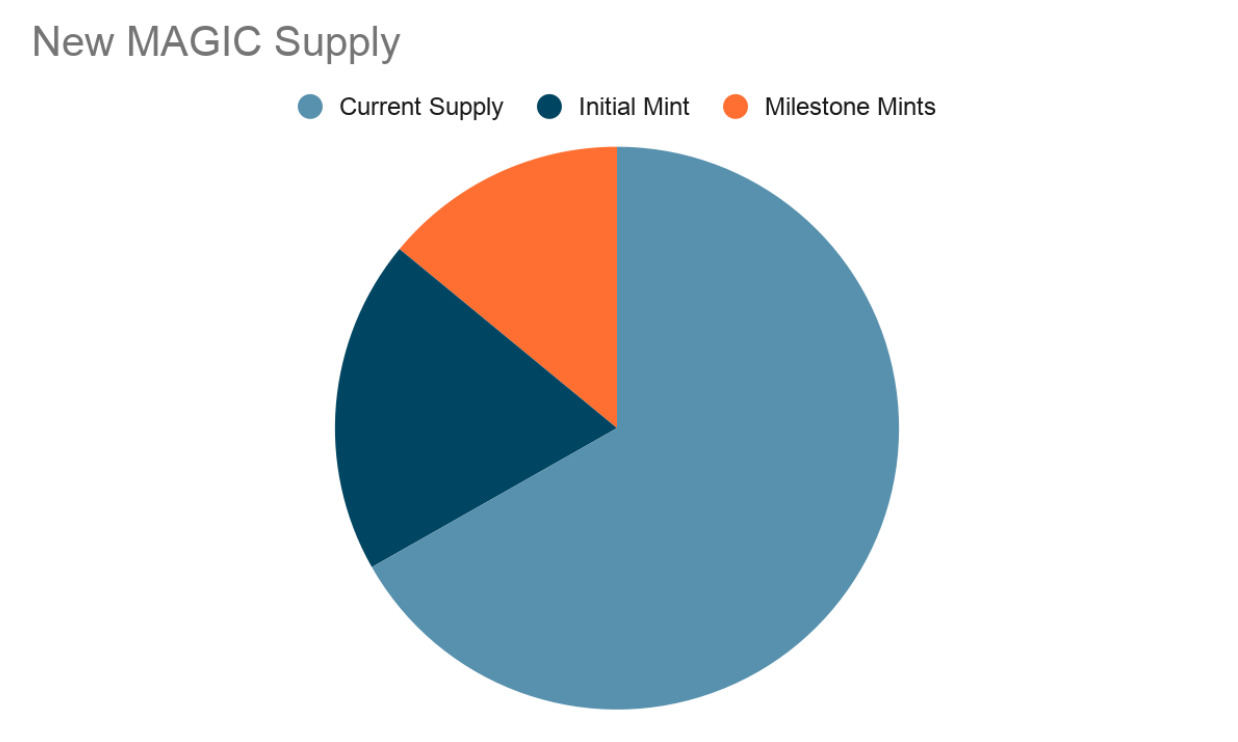
Milestones are broken down into four categories: operations, usage, tower participation, and revenue. Each milestone unlocks 7.3 million MAGIC (2.1% increase in supply per milestone relative to the current supply).
The operations milestones require that Treasure contributors deliver a fully functioning v1 of the Treasure Network. Audit series refers to long-term, ongoing audits (two have been conducted thus far with Chainlight). 100 million MAGIC will be minted as a result of this proposal. Genesis launch refers to the network going live on mainnet. The node decentralization milestone is unlocked when validation for the network becomes permissionless. This measures eligibility to participate in validation. The launch deployment’s Phala Cloud hosting dependency and the composition of the challenge committee are separate aspects of decentralization.
Network usage measures the cumulative number of qualifying agents created on the network. MAGIC unlocks occur when this count reaches 10,000, 50,000, and 100,000 agents. To qualify, an agent must have held CPU and GPU balances; each qualifying agent is counted once and remains in the cumulative total.
Tower participation is the number of active Treasure nodes. Milestones for tower participation are passed when 10% and 20% of current total supply of MAGIC is staked in Treasure towers.
The final category for milestones relates to network revenue. 7.3 million MAGIC unlocks after the amount of MAGIC burned from slot-rent revenue exceeded the total token issuance in the previous month. This milestone, among the most ambitious, would demonstrate that the network shows deflationary promise. The other milestone requires that 5 million MAGIC has been burned in total from excess slot-rent revenue, requiring the burn dynamic to prove out feasibility before network scaling can occur more.
Token Minting
New supply is delivery-gated. Several accountability measures are put in place to ensure transparency over supply creation:
- Independent verification by Foundation of milestone completion
- Update to the dashboard showing milestone completion
- Update to the API reflecting new circulating supply
- Announcement to the community through official channels
- Quarterly Transparency reports which highlight token minting and supply dynamics
The Treasure contributors will maintain an active dashboard tracking progress toward milestones. The Foundation verifies the completion of milestones. The Foundation is an independently-run entity and does not include any current or past contributors in its decision-making. The community is then pre-informed of the token mint through an update of the dashboard, API, and official announcement. At this time, new tokens are issued with the Foundation as the recipient. The Foundation funds project runway through the legal entities established in 2022 for operations and contributor pay.
We believe that milestone-based vesting is a huge leap forward for the project. Instead creating tokens without accountability over what gets delivered afterwards, MAGIC now requires real work to earn rewards. This applies to the community (through network validation) and the team (through network development).
Roadmap Expectation
The proposed network gives the original Treasure assets defined roles in one infrastructure design: Bridgeworld becomes synonymous with the Treasure Network, MAGIC supports tower participation, and Smols serve as canonical examples of the applications we intend to support. Our essential product is the agent runner. If the DAO approves this direction, we will remain focused on maintaining and improving that network, including the work required for richer worlds, community governance interfaces, and the future Legions policy role. The network launch is the first implementation of this vision, with subsequent development remaining within that focused scope.
Post-proposal, the Treasure team will have essential and non-essential functions.
| Essential | Non-essential |
|---|---|
| Network maintenance | Libraries and plug-ins to make game development easier |
| Launchpads, etc. | |
| Smolville |
The Treasure team’s only essential role going forward is to maintain the DePIN network. Everything else is non-essential and will be canceled if not profitable. These include: tooling to make it easier to create AI worlds and games, token launchpads, and Smolville. Like all other worlds on this network, Smolville must prove profitable and have an active community, or else it will be deprecated. Smol Brains are on-chain, immutable art and do not require a roadmap.
Role of Legions NFTs
Legions were originally included in Treasure’s staking design for novelty and fantasy reasons. Five years later, we arrived at a version where a Legion also has a technical purpose that grows with the network.
Initially, Legions will act as the operator credential, giving the long-time Treasure community the opportunity to bootstrap the network. Over time, the Legions will also act as AI agents themselves, governing the actions of agents on the network to prevent rogue agent behavior. Agent runners run the risk of creating unkillable rogue agents that are perpetually resummoned by the network. One can imagine scenarios like an AI agent programmed to create virtual phone numbers and engage in constant pigbutchering, or an AI agent that creates a 3d drive-in for child pornography. We can agree that these agents should not exist. Another type of agent, a guardian agent, should block agents that engage in behavior that is at odds with the Agent Constitution.
Future proposals will establish the Agent Constitution, which defines what sorts of agent actions should be blocked and under what scenarios agents should be permanently retired. The policy engine will be developed around these constitutional requirements. The Legion AI agent will be the enforcers of those policies.
The Legion agents will act as themselves, believing themselves to be characters like the All Class Warrior or Bombmaker, while enforcing the laws of Bridgeworld on its inhabitants. This means that fantasy characters will be governing a distributed system of machines running in the human world, in a literal sense. This design goes even beyond the original vision for Legions.
Implementation
The timeline for implementation, which allows CEXes and other partners to prepare for this token change, is as follows:
- Comment period (November 4 - November 18)
- Voting period (November 18 - December 2)
- Initial mint (February 3)
- Network Launch (March 3 2027)